


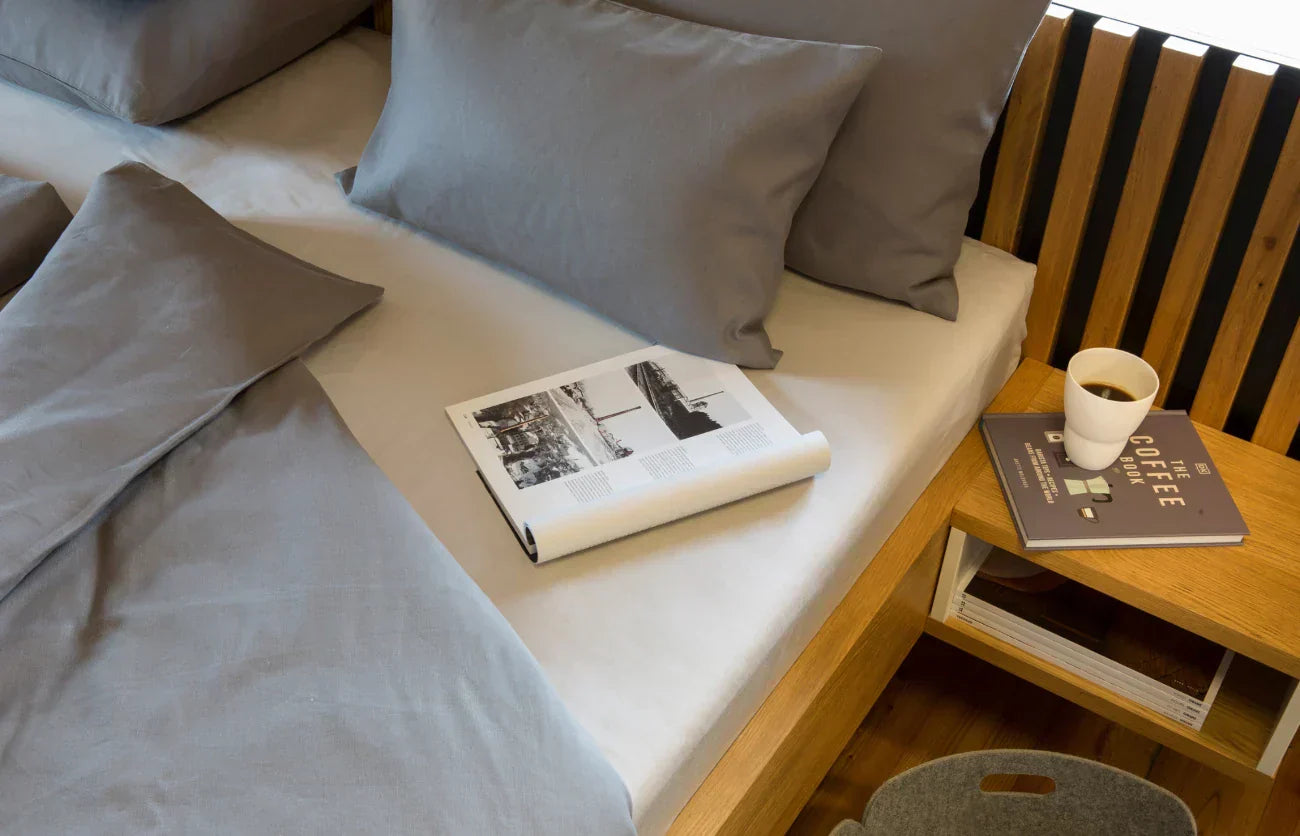
Linen is one of the oldest textile plants, with a history spanning thousands of years. Find out where linen comes from, how it is grown, what its typical properties are, and why we chose it, in combination with lyocell and cotton, for our bedding collections.
Growing flax and processing it into linen yarn
The linen we use at Lejaan comes from France. This region has ideal climatic conditions and soil for its cultivation, and it is also undemanding, requiring low amounts of nutrients, which makes it an ecologically sustainable crop. It is sown in spring, and thanks to its rapid growth (approx. 4 meters in 3 months), it is harvested in summer. The entire plant is processed to extract fibers not only from the stem but also from the roots.
After harvesting, the flax is spread on fields where it is exposed to moisture, sun, and wind. This process, known as retting, breaks down pectins (pectin = a natural substance in plants that acts as a glue connecting fibers in their stems) and allows the fibers to separate. This is followed by mechanical scutching and spinning the fibers into yarn, which is used for weaving linen fabrics.

Week in Porto Collection – 50% linen, 30% TENCEL™ Lyocell, 20% cotton
Typical properties and main benefits of linen
If you are looking for a material that is, thanks to its properties, an ideal choice for bedding, then it is linen. It excels in excellent thermoregulatory properties, providing ideal thermal comfort in winter while wicking away moisture and providing a cooling sensation in summer. It is also naturally resistant to high temperatures and physical stress, which ensures its long lifespan and easy maintenance. Additionally, linen does not accumulate electrostatic charge and is hypoallergenic.
Despite its many advantages, linen also has some disadvantages, such as a tendency to wrinkle or a rougher texture. However, these properties can be balanced by combining it with other materials, such as lyocell or cotton.
Combination of linen, lyocell, and cotton
At Lejaan, we decided to utilize the long-known advantages of linen and complement them with lyocell and cotton for an even better result. TENCEL™ Lyocell, made from eucalyptus tree cellulose, brings softness, smoothness, and reduces wrinkling to our products, while cotton simplifies care. This combination preserves the natural qualities of linen, such as durability and thermoregulatory properties, while minimizing its disadvantages.

Stone Miracle Collection – 50% linen, 30% TENCEL™ Lyocell, 20% cotton
Sdílet:
Sleep under the stars in Lejaan bedding
Wool: The perfect companion for the colder months